


Views: 0 Author: Site Editor Publish Time: 23-12-2025 Origin: Site


In the global sourcing landscape of 2025, procurement decisions are no longer based solely on the "Price Per Roll." Smart buyers are analyzing the Total Landed Cost—which includes freight, storage, and waste disposal.
As a manufacturer directly controlling the coating and slitting process, Xinzhu Material releases this technical report. We analyze the fundamental structural differences between Direct Thermal Linerless Labels and Standard Thermal Labels, providing factual data to support your sourcing strategy.
(This is based on standard industry material specifications)
The most significant "hidden cost" in the label industry is the Glassine Liner. It provides no function after the label is applied, yet it accounts for nearly half of the material volume.
Here is the physical comparison data derived from our standard production specifications:
| Material Structure | Face Stock (Thermal Paper) | Release Liner (Glassine/PET) | Total Thickness | Efficiency Ratio |
|---|---|---|---|---|
| Standard Thermal Label | ~75-80 microns | ~60-65 microns | ~140 microns | ~55% Usable Product |
| Xinzhu Linerless Label | ~75-80 microns | 0 microns (None) | ~80 microns | 100% Usable Product |
Technical Insight:
By removing the ~60-micron liner, the Linerless Material is approximately 43% thinner than the standard material. This physical fact is the direct source of the "40% Savings" in storage and transport space.
(Data based on standard 20ft Shipping Container limits)
For international buyers importing from China, ocean freight is a major cost component. Sourcing Linerless materials fundamentally changes the Volume-to-Value ratio.
We compared the loading efficiency of a standard 20ft container for Jumbo Rolls:
Scenario A: Standard Thermal Labels
Total Weight Loaded: ~18 Tons
Weight of Face Stock (Usable): ~10.8 Tons
Weight of Liner (Waste): ~7.2 Tons
Conclusion: You are paying freight to transport 7.2 tons of waste.
Scenario B: Direct Thermal Linerless Labels
Total Weight Loaded: ~18 Tons
Weight of Face Stock (Usable): ~18 Tons
Weight of Liner (Waste): 0 Tons
Conclusion: 100% of your freight cost goes towards usable product.
Supply Chain Implication:
Switching to Linerless materials effectively reduces your logistics cost per square meter by nearly 40%, protecting your margins against fluctuating ocean freight rates.
When calculating the ROI (Return on Investment), many procurement managers overlook the "End-of-Life" cost.
Based on global waste management standards, the silicone-coated liner used in standard labels is classified as industrial waste.
Standard Label Cost Cycle:Purchase Price + Freight + Storage + Disposal Fee (Liner)
Linerless Label Cost Cycle:Purchase Price + Freight + Storage + 0 Disposal Fee
Xinzhu Manufacturer Note:
Our Eco-Friendly Linerless Solutions eliminate the disposal stage entirely. This is not just an environmental claim; it is a direct cost saving for your downstream clients (retailers and logistics hubs).
In 2025, material compliance is strictly enforced by customs in the EU and Americas. Xinzhu Material adheres to the following verifiable international standards:
BPA-Free / Phenol-Free:
Our chemical formulations comply with the latest restrictions on Bisphenol A (BPA) in thermal paper.
REACH Regulation (EC 1907/2006):
All raw materials used in our Top Coated Paper and Synthetic Paper series meet the Substance of Very High Concern (SVHC) limits.
RoHS Directive:
Ensures our materials are free from hazardous substances like heavy metals.
Why this matters:
Sourcing from non-compliant workshops creates a risk of customs seizure. Xinzhu Material provides Technical Data Sheets (TDS) and compliance certificates with every batch to ensure safe market entry.
To support the growing demand for high-performance materials, Xinzhu has optimized our production lines for 2025.
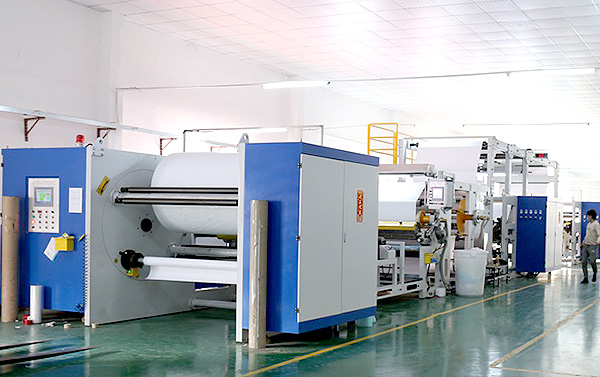
Production Capacity: We operate high-speed coating lines capable of producing Jumbo Rolls with precise tension control.
Customization Range:
Substrates: Paper, PP, PE, Synthetic.
Adhesive: Permanent, Removable, Deep-Freeze.
Dimensions: Customized slit widths to fit any converting machine.
The data is clear. The shift to Direct Thermal Linerless Labels is supported by physics (thickness reduction), economics (freight efficiency), and regulations (waste reduction).
For converters looking to optimize their supply chain in 2025, the question is not "if" but "when."
Get the Real Specifications.
Don't rely on estimates. Contact Xinzhu Material to get the exact Technical Data Sheet (TDS) and a calculated quote for your specific volume.
